
Every problem we have ever seen with a delivery was a problem of access, not of distance. A table can travel two thousand kilometres without incident and then stop permanently at a turn in a staircase. The good news is that this is the one part of the process you can settle entirely in advance, with a tape measure and fifteen minutes.
Measure the route, not the room. The room already fits — you designed it that way.
The Route, Step by Step
Walk the path the piece will take, from the street to its final position, and write down the narrowest point of each stage:
- Entrance door. Width with the door open, measured between the frames — not the nominal size.
- Corridors. Width, and more importantly the diagonal at every corner. A 90-degree turn in a 110 cm corridor is where most tops stop.
- Staircase. Width, headroom, and whether there is a landing that requires the piece to be turned.
- Lift. Internal depth, width and height, plus the door opening — which is often the smaller number.
- Interior doors along the way, including the one into the final room.
A tabletop can travel on its edge, which means the relevant figure is usually its thickness against the door width and its length against the corridor diagonal. A 240 × 100 cm top passes through a 90 cm door comfortably on edge and fails a tight stairwell turn regardless of the door.
Weight Is Not the Obstacle People Expect
A 4 cm solid wood and resin top is genuinely heavy — a two-metre dining top with its steel base is a two-person lift at minimum, often more. But weight is a solved problem: it determines how many people arrive, not whether delivery is possible.
Access is the unsolved one. This is why we ask about stairs before we ask about postcodes.
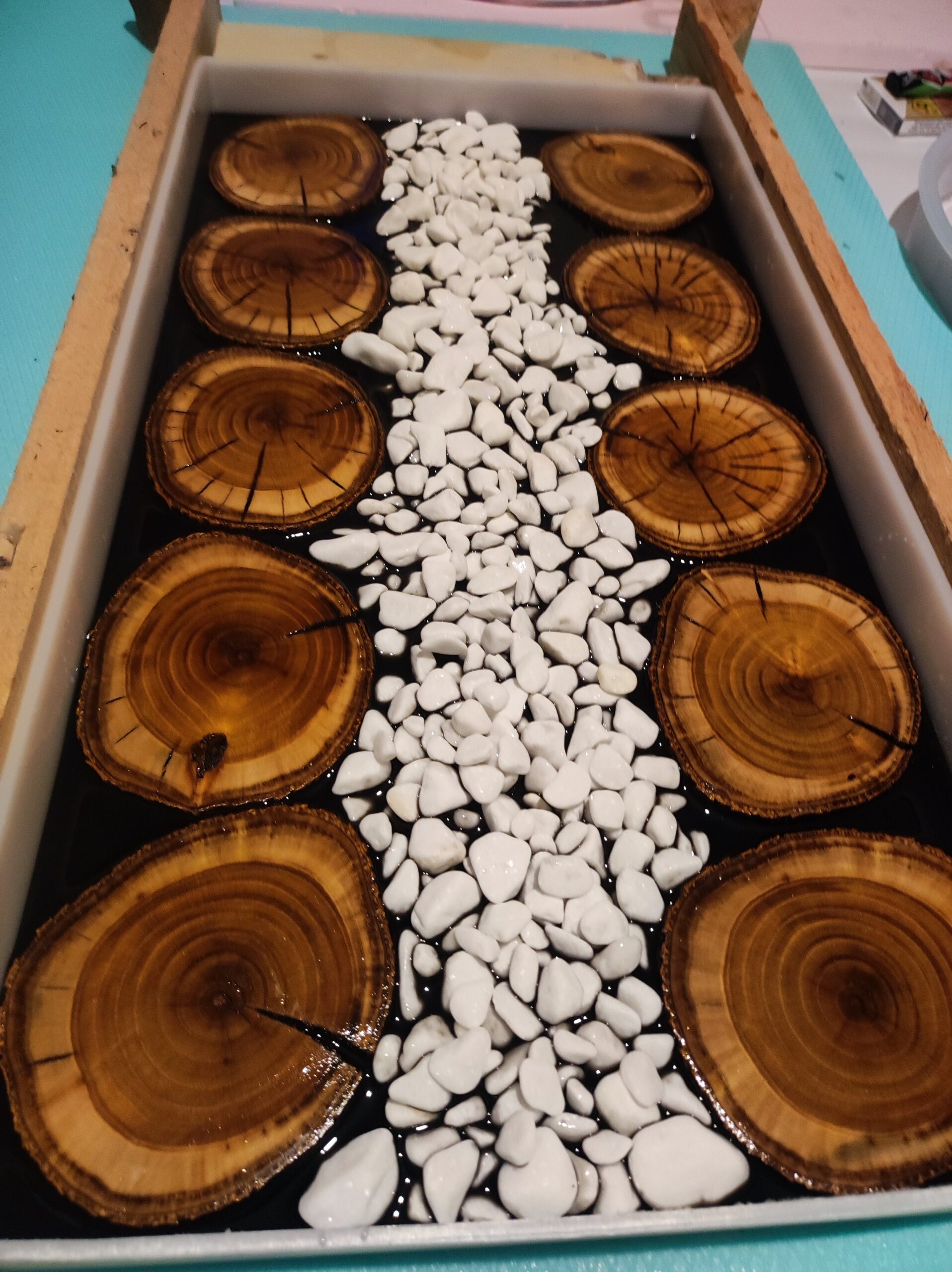
How Delivery Is Calculated
Transport is arranged by us and quoted individually rather than taken from a table of rates. Three things set the figure:
- Destination — distance, and whether the address is reachable by a full-size vehicle.
- The piece itself — dimensions and weight decide the vehicle and the crew.
- Access — a ground-floor entrance and a fifth floor without a lift are different jobs.
Because every piece is a different size, a flat shipping rate would either overcharge small commissions or underdeliver on large ones. The cost is confirmed before production begins, not after.
On the Day
The piece arrives wrapped and is unpacked in the room where it will stand, not at the door — packaging is the only protection it has against door frames. The base is fitted in place, the top is set onto it, and the surface is levelled.
Levelling matters more here than with a manufactured table. A slab top is rigid and heavy, so an uneven floor shows up as a rock rather than a flex. Adjusting at the moment of installation takes minutes; doing it later means lifting the top again.
The First Week
Give the piece a few days in the room before judging it. Wood and resin both respond to a new environment — a workshop and a heated apartment are different climates — and the surface settles visually as the light in the room moves across it during the day.
Two practical points for that first week:
- Keep it out of unbroken direct sun while you decide on the final position. The reasoning is in Are Epoxy Resin Tables Durable?
- Use felt pads under anything metal or ceramic that lives on the surface permanently.
After that, the routine is a damp cloth and nothing else — the full ritual is in How to Care for an Epoxy Resin Table.
If the Route Does Not Work
It is almost always solvable, and always cheaper to solve before the slab is cut. Options in order of preference: reduce the top by a few centimetres, split a very large surface into a two-piece design, change the base to one that assembles in the room, or — for genuinely inaccessible spaces — design the piece around what the staircase allows.
This is one of the arguments for commissioning rather than buying finished: a bespoke surface can be sized to the corridor as easily as to the room. The full process is in How to Commission a Custom Table, and the made-to-order range is in Bespoke & Made to Order.
Quick Answers
What should I measure before delivery?
The narrowest point of every stage from street to room: entrance door, corridor corners, staircase width and headroom, lift door opening, and interior doors.
How much does delivery cost?
It is calculated individually from destination, the dimensions and weight of the piece, and access at the address. The figure is confirmed before production starts.
Do you assemble the table?
Yes. The base is fitted and the top levelled in the room where the piece will stand.
What if the table will not fit up my stairs?
Tell us before the slab is cut. Dimensions can be adjusted, a large surface can be designed in two pieces, or the base can be changed to one that assembles in the room.