
Buying furniture from a shelf takes ten minutes. Commissioning a piece takes a month, and most of that month is ours, not yours. But the first hour is yours, and how you spend it decides whether the finished table fits the room or merely arrives in it.
A commission is not a longer purchase. It is a shorter conversation about a longer object.
Before You Write: Four Numbers and One Photograph
Almost every question we would ask you can be answered before you send anything. Have these ready and the process shortens by days:
- The room, not the table. Length and width of the space the piece will occupy, including the distance to the nearest wall or furniture on every side.
- How many people sit at it — on an ordinary evening, not at Christmas.
- Where the light comes from. A window on the left changes which side of a live edge is worth showing.
- Ceiling height, if a pendant will hang above it.
- One photograph of the room as it is today — including whatever furniture is staying.
If you are unsure about dimensions, the reasoning behind each number is in our sizing guide. A rough measurement is far more useful than none.
Step One: The Inquiry
You send the above through the contact page, or you point at a piece in Bespoke & Made to Order and say “like this, but 187 cm.” Both are equally good starting points. Naming an existing design is often faster than describing one from scratch, because it fixes the language: you have already told us about the channel, the edge and the finish in one word.
Step Two: The Proposal
We come back with a specific combination rather than a catalogue. That means a wood species, a channel treatment, a base, exact dimensions and a price. Each of those is a decision with consequences:
- Wood. Walnut, oak, elm or ash — each with a different colour temperature and grain. The differences are set out in Choosing the Wood.
- The channel. Clear and quiet, carrying natural stone, or lit from within.
- The base. Powder-coated steel, positioned so chairs slide under freely.
- The finish. High gloss returns light; satin absorbs it and hides fingerprints.
Step Three: The Slab
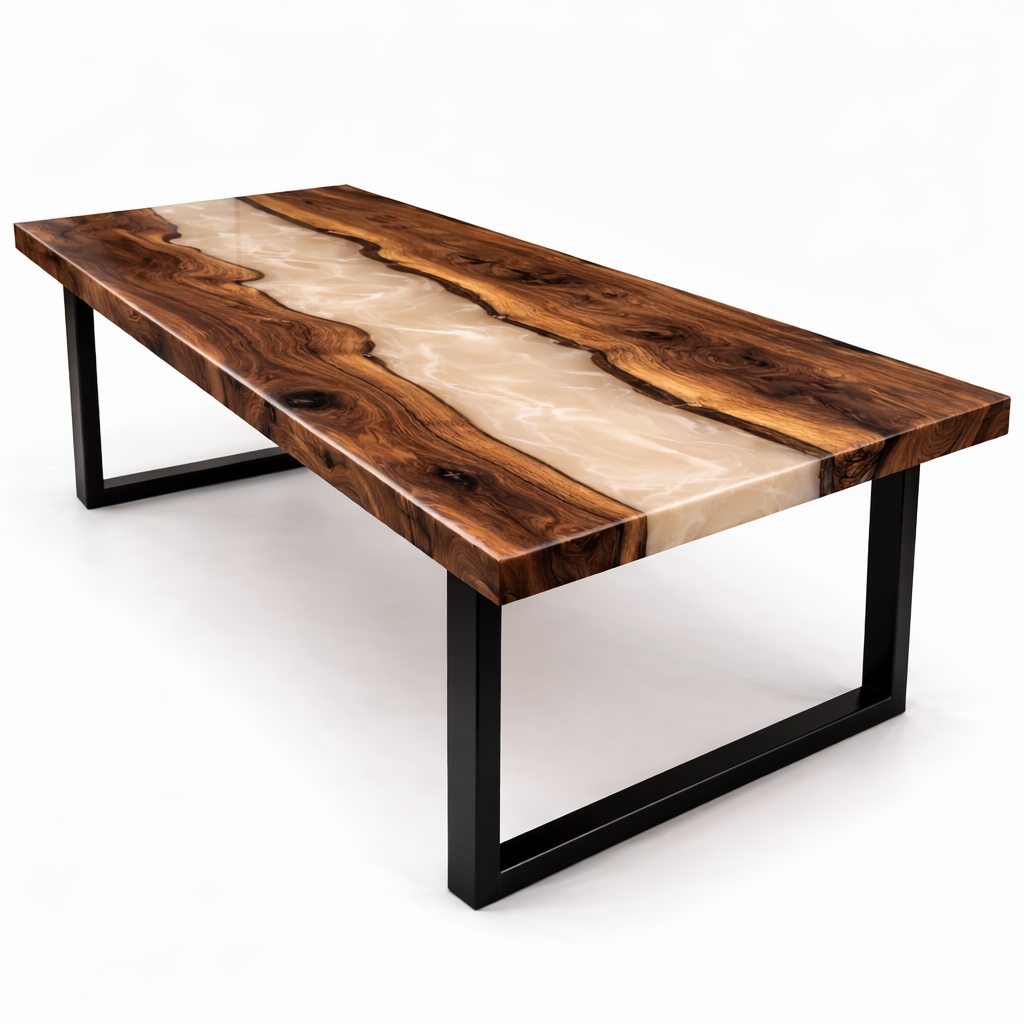
Once the proposal is agreed, a specific slab is selected for your piece. This is the point where the commission stops being a description and becomes an object. The live edge you get is the live edge that tree had, and it determines the shape of the channel that runs beside it.
This is also the last moment at which dimensions can change. After the slab is cut and flattened, a table cannot grow.
Step Four: The Twenty-Five to Thirty Days
Drying, sealing, layered pouring, curing, levelling, sanding through progressive grits, polishing, base fitting. Most of it is waiting, and the waiting is the part that cannot be recovered later — the full breakdown is in Why 30 Days.
You do not need to manage any of it. The one thing worth doing during this month is checking the delivery route into your home, because that is the only remaining variable that can go wrong.
Step Five: Delivery
Transport is arranged by us and calculated individually — it depends on the destination and on the size and weight of the piece, so it is quoted rather than tabled. Access matters more than distance: a 240 cm top and a narrow stairwell is a harder problem than a border crossing.
What Actually Moves the Price
Six things, in roughly this order of weight:
- Size. Not linear — a wider slab is disproportionately harder to source and pour flat.
- Wood species and slab quality. A single-piece walnut slab with a clean live edge is a different object from a jointed one.
- Channel complexity. Clear resin is straightforward; suspended stone or preserved moss is hand-placed work that cannot be revised.
- Integrated lighting. The LED system is built in during the pour, not attached afterwards.
- Base. Standard steel versus a custom profile.
- Finish. Mirror polish takes more passes than satin.
This is why pieces made to order carry an inquiry rather than a fixed price: two tables of the same length can differ substantially once the slab and the channel are decided.
Quick Answers
How do I start a commission?
Send your room dimensions, the number of seats and a photograph through the contact page. Referencing an existing design speeds things up considerably.
Can I change the size after ordering?
Until the slab is cut, yes. After that the dimensions are fixed, because the piece is built from one specific piece of wood.
How long does the whole process take?
Production is 25–30 days from the agreed proposal. Add a few days at the start for the exchange and a delivery window at the end.
Do you work with interior designers?
Yes. Designers usually arrive with drawings and a fixed opening, which is the easiest possible brief to build to.